

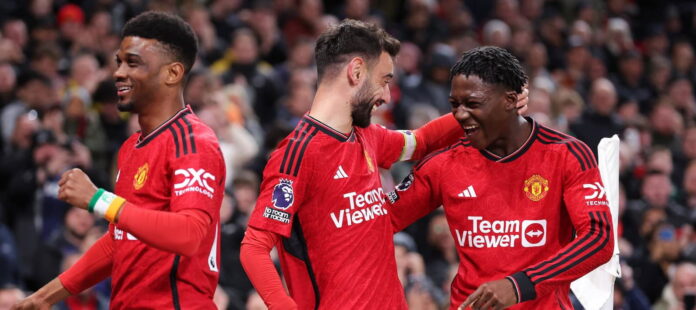

Formations are a funny old thing. A series of numbers more reminiscent of a Fibonacci sequence than a description of eleven footballers on a pitch, the term has dominated the conversation around Manchester United since Ruben Amorim‘s arrival from Sporting CP fourteen months ago. However, INEOS sent shockwaves through the club on Monday morning by deciding to dismiss the Portuguese coach, along with his 3-4-2-1 formation, bringing an end to his tumultuous tenure. In Amorim’s place, Under-18s coach Darren Fletcher has been given stewardship of the senior side, leading United to a hard-fought 2-2 draw with Burnley at Turf Moor last night. The 41-year-old is only a temporary measure, however, with the club set to appoint a permanent caretaker until the end of the season. A long-term replacement for Amorim will then be selected over the summer, when the pool of candidates grows. Ole Gunnar Solskjaer, formerly an interim manager before being handed the reins full time by Ed Woodward, is the favourite for the caretaker role. Michael Carrick is also in the running — another ex-player who temporarily managed United, ironically, following Solskjaer’s dismissal in 2021. There is also a faint possibility Fletcher remains in place if the club’s hierarchy receive positive feedback this week, but the sense is that it will be Solskjaer who is once again handed the keys at Old Trafford. Regardless of whoever INEOS eventually select, there is a full expectation of a return to a formation with a back four and wingers — reflecting the attacking ethos of the Red Devils — as Fletcher opted for at Turf Moor last night. The Scot set up with a 4-2-3-1, the same formation Solskjaer utilised during his time in charge — and the performance deserved all three points, particularly from an attacking perspective. Man United attacking dominance vs Burnley TeamGoalsxGShotsOn targetPossession Burnley20.247135% Man United22.25301065% But the team at Fletcher’s disposal was understandably weakened by the continued absence of Amad, Bryan Mbeumo, and Noussair Mazraoui — all representing their countries at the Africa Cup of Nations — as well as a long line of players with, or having just returned from, injuries. For example, United fans are unlikely to see Patrick Dorgu on the wing again, nor a centre-back partnership of Ayden Heaven and Lisandro Martinez, and a midfield pivot of Casemiro and Manuel Ugarte will only be brought out for brutal away fixtures — not against newly promoted Burnley. But what are we likely to see? The Peoples Person has analysed the United squad, with its full ensemble fighting fit and available, and this is what we believe is the best line-up for the new caretaker, whoever they may be, to utilise until the end of the season. Goalkeeper Despite being the lowest-profile recruit in the summer, Lammens has given United the biggest bang for their buck this season. Signed from Royal Antwerp for just £18.1 million, after INEOS overruled Amorim’s demand for Emiliano Martinez, the 23-year-old goalkeeper is easily one of United’s best transfers in years. Lammens has quietly established himself as the first name on the team sheet, with a series of mature performances — in the most pressurised position on the pitch — that belie his age. The Belgian hasn’t relied on showy saves or pinpoint passing. Instead, he has delivered consistency and composure — goalkeeping fundamentals fans have been screaming for after the erratic displays of his predecessors, Andre Onana and Altay Bayindir. Regardless of a back four, or flying wingers, or false nines, United have their No. 1. Defence Amorim’s three-man defence should, in theory, have made United more robust at the back. But theory rarely translates to practice at Old Trafford, as the 32 goals conceded this season demonstrates. Across the entire Premier League, only title chasers Arsenal and Manchester City have scored more than United. But 13 teams have better defensive records, with the Red Devils bettering only the bottom six. United’s cohort of centre-backs were largely uncomfortable fits in a back three, with their individual quality leading to good performances, rather than any sense of a collective effort. The full-backs on either side — Diogo Dalot and Noussair Mazraoui on the right, Luke Shaw and Patrick Dorgu on the left — were also ill-suited to the demands of the wing-back role. As such, a switch to a back four should help shore up the problem end of the pitch. Mazraoui is the best fit at right-back, as is Shaw on the opposite side. Dalot offers the versatility to cover both positions, but lacks the quality to start in either, while Dorgu can provide an attacking thrust down the left from the bench against tired legs. Matthijs de Ligt has been the team’s best defender by a country mile this season, so the Netherlands international picks himself in central defence. And it’s a fellow Ajax acolyte, Lisandro Martinez, who should be deployed next to him, with El Carnicero’s distribution as good as any centre-back in world football. Leny Yoro, 20, and Ayden, 19, can resume their rightful roles as talented youngsters fighting for first team minutes, while Harry Maguire’s experience in the dressing room is more important than his contributions on the pitch at this late stage of his career. Midfield The weakest area of the pitch, with many of the defensive problems stemming from the sieve of a midfield United have lined up with this season. Over £100m was spent on three defenders in INEOS’s first transfer window in charge, with another two signed in the next. In the following window, nearly £200m was invested on the attack, with three high-profile signings arriving. Only one midfielder has been signed in this time. It’s natural, therefore, that the engine room has fallen into a state of disrepair in this time, given this almost wilful neglect — but the effect has now cost another coach their job, though it is an issue which pre-dates INEOS. United’s focus this summer will be an overhaul of the midfield, with a range of targets — including Nottingham Forest maestro Elliot Anderson and Brighton dynamo Carlos Baleba — on the club’s radar. In the meantime, the caretaker manager will have to make do with one of Casemiro or Manuel Ugarte next to Kobbie Mainoo, with the 20-year-old starlet set to be the biggest beneficiary from Amorim’s departure. Mainoo is yet to start a league match this season, having fallen firmly down the pecking order under Amorim. There was a major training ground bust-up between the pair last year, which may have influenced this. But the reality was he simply did not fit the Portuguese coach’s system, lacking the physicality to play in a double pivot or the attacking guile to be a No 10. A shift towards a midfield three suits Mainoo’s skillset, while masking his weaknesses. Ugarte offers more energy and tenacity than Casemiro, whereas the former Real Madrid man provides better ball progression and leadership. Neither are ideal partners for their English teammate, however, and it will depend on the opposition who receives the starting nod next to him; Casemiro against sides United will look to break down, Ugarte in the reverse. There may even be games — such as Arsenal away in two weeks’ time — where they both play, and Mainoo drops to the bench. Make no mistake though, Casemiro and Ugarte should both be sold at the earliest opportunity, with two new midfielders arriving in their place. The Uruguayan is likely to start more often than the Brazilian until then, having shown notable improvements in recent weeks. The third option needs no explanation: Bruno Fernandes should start every minute of every match he is available. Similar to Mainoo in a midfield trio, the Portuguese talisman will be unburdened of the defensive shackles Amorim forced upon him, and able to offer even more attacking threat in the second half of the season. Attack The part of the team with the most difficult decisions to be made, precisely because of the stark differences between a 4-2-3-1 and a 3-4-2-1 formation. Last summer, United shifted four wingers — Alejandro Garnacho, Antony, Jadon Sancho and Marcus Rashford — after Amorim designated them as members of his infamous ‘bomb squad’. Their crimes were not their position, but their quality on the pitch or their attitude off it. Regardless, this cull has left the team with only two natural widemen, Amad and Mbeumo, who both play on the same side. Neither can be dropped as they have been United’s most potent attackers this season. Matheus Cunha is more comfortable on the left, as last night’s performance against Burnley demonstrated. But the Brazil international is not an out-and-out winger; rather, he does his best work in the half-space between the opposition full-back and centre-back — exactly where Amorim’s system placed him. So we are left with two excellent options on the right, and no right choice for the left — which means a compromise, who misses out? Ironically, it is none of the three. Instead, it is Benjamin Sesko — the Slovenian international, signed from RB Leipzig for £74m in the summer — who will drop to the bench, with Mbeumo moving up top, a position he has previously played for Brentford. Amad will take the right wing, instructed to stay high and wide, while Cunha starts on the left, with the freedom to drift inside. The left-back, be it Shaw or Dorgu, will then be told to provide a constant overlap to exploit the space the Brazilian’s wandering creates. Mbeumo will offer a threat in behind with his scintillating speed and fantastic finishing. The trio will form a fluid frontline, with Mbeumo and Cunha constantly swapping positions, as Mainoo and Fernandes push forward to join the attack. And should United need a goal, their bench will include a 6’5 Slovenian wrecking ball chomping at the bit to get on the pitch, and Mason Mount — a source of inventiveness and industry in equal measure. Conclusion – Starting XI Lammens Mazraoui De Ligt Martinez Shaw Ugarte Mainoo Amad Fernandes Cunha Mbeumo A 4-2-3-1, as Fletcher deployed last night, and Solskjaer would most likely maintain if he takes the reins until the summer. But it can easily morph into a 4-3-3, or even a 4-4-2, with Sesko starting up front and Fernandes dropping deeper into midfield. Either way, the back three is dead, the order of four is restored. Long live the King, be he Scottish or Norwegian, as long as he isn’t Portuguese. The coronation of a new formation is imminent. Featured image Alex Livesey via Getty Images The Peoples Person has been one of the world’s leading Man United news sites for over a decade. Follow us on Bluesky: @peoplesperson.bsky.social





© 2025 Manchester United North America. All Rights Reserved. Desigb by CODEUS.