

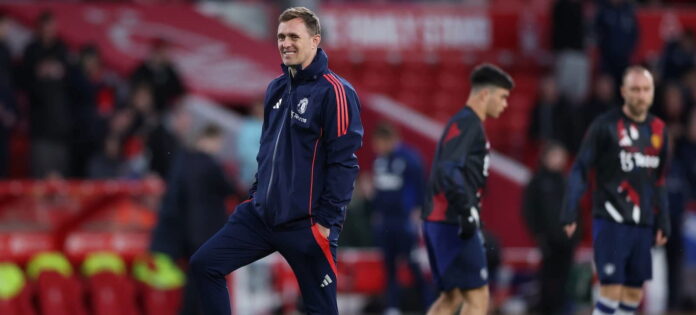

Darren Fletcher was addressing the media this afternoon in his first press conference as interim manager of Manchester United. Fletcher was speaking at the pre-match press conference ahead of tomorrow evening’s Premier League encounter with Burnley at Turf Moor. The first part of the presser can be read in full here. Here is every word of the second, embargoed section. The first question was whether he will revert to a back four. “Well, we don’t know yet. I can’t disclose that,” he said. “I think when you talk about the Under-18s teams, that’s a style and a system that the club thinks is best for developing players. So I think it’s a system that we use. I think it’s something that’s come in in terms of how we set up in midfield, how we set up with defenders. So I think for developing players, it’s a really good formation and system. And at Under-18s, it’s about development. So I think that’s the important thing for us is when I’m leading the Under-18s, I’m trying to develop players. So you’re picking teams, you’re experimenting, you’re doing different things, you’re challenging them, you’re playing young players. So of course, you try and win every football game, but fundamentally, we’re trying to develop players, and that formation definitely suits that. So that’s a club formation that we – and it’s a formation that I’ve been used to playing for a long time as well.” Speaking to former managers Fletcher was then asked if he spoke to Ruben Amorim before he left. “I didn’t have the chance,” he said. “I’ve reached out to him, I’ve not managed to make contact yet, but that’s understandable. He’s obviously got a lot on his mind and I have been really busy, so I’ve not had the chance to. I’d love to because I had a good relationship with Ruben. He was great with me. He was very welcoming to me and to his staff at the end of last season in terms of being the Under-18s coach, in terms of small communication I’ve had this year because I’ve been on another side of the building.” “Always good interactions. And ultimately, he’s the manager who gave my son his debut as well. So as a father, I’ve got a lot to thank him for. And Tyler, although the boys have gone on there and that themselves, he was the manager that did that. So I’ve got a good relationship with Ruben, so I’m disappointed, and obviously for him. But what’s happened, has happened, and I’m here to try and help the club, and we have to move on quickly. And as I said before, everything I do is with the best interests of the club, and that’s why all my focus is energy, is going into Burnley.” Has Fletcher spoken to Sir Alex since he got the call? “I have,” he said. “I don’t like to make any major decisions or things without speaking to Sir Alex. And that’s something I’ve done since I’ve been at the club and since I’ve left the club and everything I do. I’ve got a really good relationship with Sir Alex. So it’s probably the first person that phoned, actually.” “So I wanted to speak to him first. And ultimately, to get his blessing, to be perfectly honest with you, I think he deserves that respect. I wanted to run it by and what he thought, and he was supportive of it. And he echoed my thoughts, which I’ve always said, It’s your job to do the best for Manchester United. When you’re an employee of the club, it’s your job to do your best for Manchester United. And it’s amazing when he says something that I try and live and believe every day. So it was comforting for me for him to say that.” Dealing with toxicity The next question was from Jamie Jackson: “Darren, you were obviously a big player here. Lots of success. You’ve been here four or five years, done all these roles. In your experience, being at United, how much do you think outside scrutiny from people like us, former players, something that you’ve got from your teammates, the whole circus. How much does that affect or can be a factor for players that are in your squad now and team performance? Do you think it matters? Do you think it has an effect? Is it part of dealing with being a United player?” Fletcher answered: “I think it has an effect because it’s part of dealing with being a Manchester United player, I can only reflect on my experience as a player, and it was there when I was a player. I was a young player. I had to come into the team in a season where we finished second and it’s the end of the world. I’ve experienced that.” “What I look back on is, and I’m very lucky, We had Sir Alex, we had Roy Keane. We had the experience around players around us who protected us and helped us. And fundamentally, that’s not the case anymore because there never will be another Sir Alex. So it is difficult, but it’s the same in every club. But Manchester United is the biggest club in the world. So that’s scrutiny, expectations, standard is there. And that’s something that you have to deal with. You have to learn to deal with. You have to get help in to deal with. It happens naturally. Some people have to take time to get used to it. I’m slowly but surely, you try and have to deal with that constantly. Personally, I think it’s life of a footballer.” “It’s a modern day world, and it’s something that the players have to learn to deal with, and they will. Sometimes it takes time, and sometimes some people can’t, and that’s just life, and that’s just the way it is. So my thing is, it’s there. Learn to deal with it, find a way, however best suits you, and embrace the challenge of being at Manchester United. Be excited by it, but recognize that there is a lot of scrutiny, and a lot of pressure, and a lot of noise.” The reporter asked “Just on that, Darren, it was something Ruben has mentioned a few times here about the noise, and especially from Pondit, an ex-teammate of yours. he mentioned it again on Sunday about suggesting what Gary Neville says influences decisions. How difficult is it for this club to get back on its feet when that thing is happening on a daily basis? Do you either need bigger characters within the club, within the dressing room, or do you need some of those ex-players to understand the situation and maybe go a bit easier on the club and the team?” “You can’t ask them to go easier because they’re passionate guys and I think they’ve a right to their opinion and they’re really good,” he said. “They’re engaged and they’re good to listen to. I enjoy listening to them. I had the years of listening to them in the dressing room I used to sit in. I did, I used to listen to them, I used to take it all in. But I think it’s… Sorry, what was the first part of the question?” The reporter replied: “It’s obviously a bigger thing that there’s more of these comments about. You can’t miss it on social media. How difficult is it for everyone at the club, not just the dressing room, but executives, coaches as well, to ignore it?” He answered: “Well, it’s difficult, but you have to. I think winning football games is important. Winning football games, winning trophies, going on a journey. That’s life, that’s football, especially here. It’s about winning. People want to win football games. People want to be entertained. People have a standard of what Manchester United is and what Manchester United expects. I think the fans, especially in Old Trafford, have been amazing in recent years, if I’m perfectly honest with you.” “I think there’s been a few moments here and there, but in general, the support that the fans have given players, managers, understanding of the situation. I think it could have been a lot worse inside the stadium. I’ve probably experienced other stadiums where it has been a lot more pressure and hostile. So maybe the players have to deal with that noise more than actual stadium pressure. So that should help. And I think the fans have been amazing in that.” “And I’m going to sit here today and ask them to support the players. Not me. Support the players in the club because they need it and they need that help. Outside noise, ex-players, it’s difficult to deal with. It’s not easy because those players have won everything. They’ve got success behind them. They’ve got trophies. So it’s hard to criticise them back because they’ve got their medals on the table. So it’s really, really difficult. But again, that’s what it is being a Manchester United player. Get your head around it, learn how you’re going to deal with it, and embrace the challenge.” Getting to know his players Had Fletcher had a chance to talk to players like Kobbie Mainoo, who was condemned to a squad role under Amorim? When is he likely to return to action? “Well, Kobbie actually did a part of the session today, but he’s going to have to be assessed tomorrow,” Fletcher revealed. “So that was part of the plan. So he’ll be assessed tomorrow. I have had conversations with players and it’s been a lot of time consuming. So I actually planned to have more conversations.” “But yeah, maybe first time experience in the first day as a Manchester United manager you don’t have as much time as you think. So in my head, I had these plans of speaking to loads of players and it didn’t pan out that way. So the conversation with Bruno, because that’s important because he’s the captain and I wanted to speak to him. Actually, I focused on a couple of players who I don’t know so well. So Matheus Cunha and Benjamin Sesko. Senne Lammens, I actually had a conversation with him not too long ago. But those two I focused on because I’ve not really got a relationship with them, and I wanted to get to know them, and I wanted them to get to know me. So the others I know well, I’ve had a relationship with them in the past, so I focused on those two, and obviously the Captain Bruno.” “And then as game time gets closer tomorrow, there’ll be some individuals, rather than being cold. When you know 95% of the squad and you don’t know those two, I think it’s important that I tried to do that.” The last question was “How would you assess the state of mind on the confidence of the players? Because it’s been obviously quite a whirlwind 48 hours for them.” Fletcher replied: “I think confidence is part and everyone’s at a different stage in confidence, and it’s really important in football. But I think you see players coming back from individual injury who have missed a lot, they’re going to be in a certain state of mind. You’ve got other players who are playing well, you’ve got other players who are not playing so well. So confidence is up and down. I think the players were… You could see that nobody likes to see somebody lose their job. Sure, you could sense that in the building yesterday. But today, you have to move on very, very quickly. And it’s important that we have a good energy going into the game. We can’t be going into the Burnley game [distracted]. It’s a game, it’s life, it’s football. “So it’s important that we try to create a little bit of energy today and a little bit of spirit. I think we got that in training today, and hopefully, there’s more of it again tomorrow. Thanks, everyone. Thanks, guys. Cheers.” Featured image Michael Steele via Getty images The Peoples Person has been one of the world’s leading Man United news sites for over a decade. Follow us on Bluesky: @peoplesperson.bsky.social Red Billy Red Billy is the managing editor of The Peoples Person, author of three books and two magazines and totally obsessed with football’s transfer market. Billy first saw United live in 1971, watching George Best, Bobby Charlton and Denis Law, before becoming a League Match ticket book holder from 1975/76 and a writer since 1995. Billy still insists Matteo Darmian and Alex Telles could have made it at United given half a chance.





© 2025 Manchester United North America. All Rights Reserved. Desigb by CODEUS.